

TwistedNail
Heavy Logistics Fleet Automation & Scale Ticket Document Vision
Core System Concept
Twisted Nail operates a heavy commercial hauling fleet transporting bulk aggregates—sand, gravel, base rock, and asphalt—across regional infrastructure projects. Every haul event generates a physical weighmaster scale ticket at the quarry or plant.
This system replaces manual paperwork handoffs with a fast document vision ingest, OCR parsing, and human-in-the-loop verification pipeline:

Quarry Scale House Document Vision & Dispatch Ingestion Pipeline
The Operational Challenge
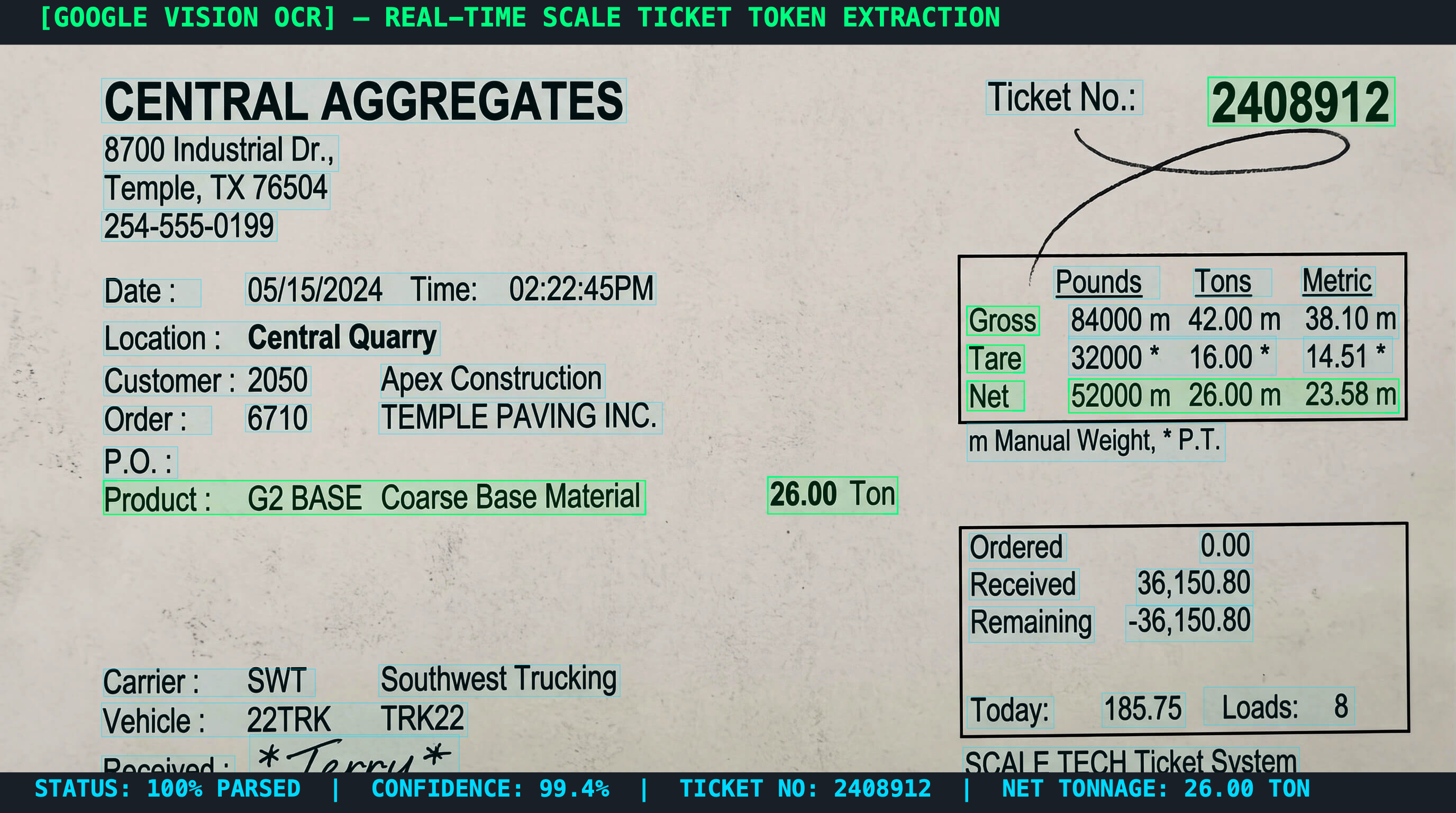
Aggregate logistics relies on physical scale houses at quarries and material pits (such as the Central Quarry in Temple, Texas). When a haul truck enters and leaves a pit, a certified weighmaster scale prints a physical paper ticket recording gross weight (84,000 lbs), tare weight (32,000 lbs), net tonnage (26.00 Tons), customer account (Apex Construction / Temple Paving), vehicle ID (22TRK), timestamps, and material types (G2 BASE Coarse Base Material).
Drivers traditionally kept paper tickets in truck cabs until handing them over in physical batches at the end of the week. Back-office billing clerks had to manually read crumpled thermal printouts and type numbers into accounting software.
This created three distinct operational bottlenecks:
- Billing Lag: Invoicing lagged behind physical deliveries by one to two weeks, delaying cash flow.
- Data Entry Errors: Faded thermal receipts and manual keying led to incorrect tonnages and disputed customer invoices.
- Reconciliation Gaps: Lost or duplicate tickets made it difficult to audit driver pay against billed customer freight.
Technical Scope & Pipeline Architecture
The system coordinates hardware scanners, cloud document vision, and relational persistence into a high-throughput workflow.
1. Ingestion & Hardware Scanner Interface
The scanning interface connects directly with desktop document scanners. Operators configure resolution, rotation, output folders, and file naming rules. Incoming images are pre-processed to normalize contrast, correct skew, and crop margins before transmission to the OCR engine.
2. Spatial Token Parsing via Google Vision API
Scale house tickets vary across suppliers (e.g., SCALE TECH Ticket Systems vs proprietary pit printouts). The OCR extraction service uses Google Vision API to extract text coordinates and bounding boxes.
A custom parser processes the raw text block:
- Identifies anchor terms (
Ticket No.,Gross,Tare,Net,Carrier,Vehicle,Customer,Product). - Extracts values using relative spatial coordinates, handling single-column and multi-column scale house formats.
- Extracts date/time timestamps to match tickets against active dispatch schedules.
3. Human-in-the-Loop Verification Console
Fully autonomous data entry on financial documents introduces unacceptable risk. Faded thermal ink or wrinkled paper can lead to misread numbers.
The verification console addresses this by presenting a split view:
- Left pane: High-contrast crop of the scanned physical ticket.
- Right pane: Form inputs pre-populated with extracted data (Ticket Number:
2408912, Truck Number:22TRK, Date:05/15/2024, Location:Central Quarry, Customer:Apex Construction, Product:G2 BASE Coarse Base, Tonnage:26.00 Tons).
Operators review values and confirm with a single keystroke or click. If an OCR misread occurs, the operator edits only the affected field without retyping the rest of the ticket.
4. Cross-Field Validation & Relational Integrity
Before persisting a record to MySQL via TypeORM, the system performs automated cross-field validation across gross, tare, and net weights. If weight calculations fail to balance due to an OCR misread or smudged printout, the interface flags the field for manual confirmation before submission.
Unique database constraints prevent duplicate ticket entries, ensuring freight invoices and driver haul logs remain consistent.
Architectural Principles Learned
- OCR without human verification creates silent financial drift: Fully automated document pipelines fail silently on low-quality thermal receipts. Providing side-by-side visual verification gives operators speed without sacrificing data integrity.
- Cross-field validation catches data entry errors early: Running automated consistency checks across related fields catches recognition errors before records reach the accounting ledger.
- Queue throughput depends on zero-friction UI: Reducing keyboard navigation and automating screen transitions between tickets allowed clerks to verify hundreds of receipts in minutes rather than hours.