

CreaVision
Multi-Camera Human Re-Identification & Deep Learning Spatial Tracking
Core System Concept
Crea.vision is an enterprise computer vision technology company based in Canada, developing advanced visual intelligence for security, surveillance, and spatial analytics.
The objective was to solve a classic computer vision bottleneck: detecting and tracking unknown humans in an environment, assigning them unique persistent identifiers, and maintaining those identities across a distributed multi-camera network:

Multi-Camera Human Tracking & Re-Identification Engine
The Tracking & Re-Identification Challenge
Standard single-camera tracking algorithms rely on spatial continuity—predicting bounding box positions between consecutive video frames. In real-world enterprise environments, this approach fails:
- Camera Handoffs & Blind Spots: When a person exits one room and enters a hallway monitored by a different camera, single-camera trackers lose the subject and assign a new ID.
- Perspective & Lighting Variance: Different cameras have varying viewing angles, focal lengths, resolutions, and lighting conditions, making simple color matching unreliable.
- Severe Occlusions: People walking behind partitions, pillars, or other individuals cause track fragmentation in off-the-shelf algorithms.
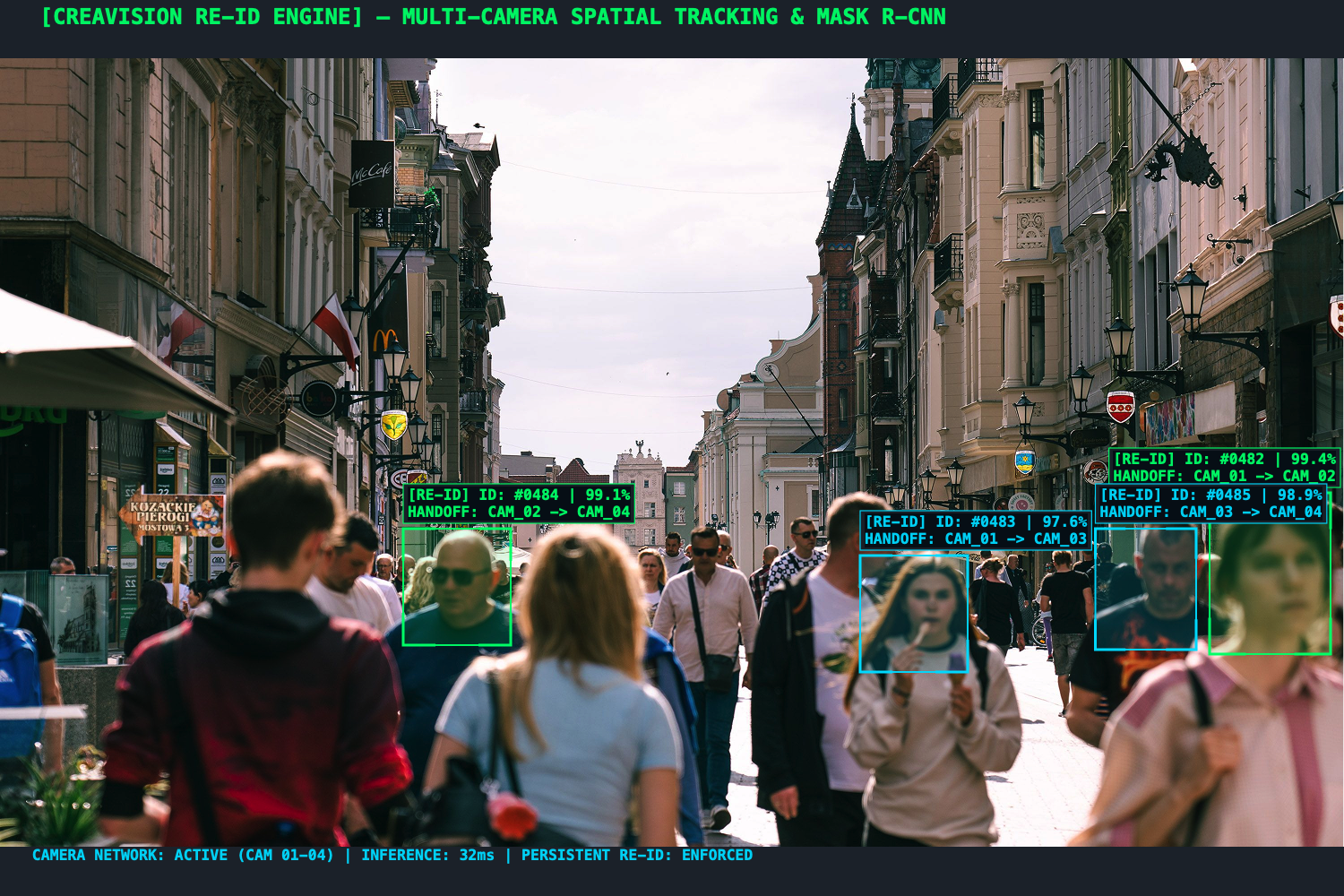
Technical Pipeline & Model Architecture
The system coordinates four distinct computer vision and deep learning stages to achieve reliable cross-camera tracking:
1. Human Instance Segmentation via Mask R-CNN
Standard bounding box detectors capture substantial background noise (floors, furniture, adjacent walls) that pollutes feature representations.
The detection stage uses Mask R-CNN to generate precise silhouette masks of each detected human:
- Isolates human subjects from background interference.
- Handles partial occlusions by segmenting visible body regions.
- Passes clean, background-subtracted image crops to the feature extraction pipeline.
2. Motion Perception & Tracklet Generation
Within each camera feed, detected persons are tracked locally to construct continuous short-term trajectory segments (tracklets):
- Combines Kalman filter velocity estimation with DeepSORT association dynamics.
- Smooths trajectory noise and bridges momentary single-frame detection drops.
- Assigns temporary local tracklet tokens to maintain spatial continuity.
3. Recurrent Neural Network (RNN) Identity Embeddings
To maintain identity beyond individual camera views, the system extracts high-dimensional appearance embeddings across sequences of frames:
- Rather than evaluating single snapshot frames (which vary wildly with body pose), the pipeline feeds sequential tracklet embeddings into a Recurrent Neural Network (RNN / LSTM layer).
- The recurrent layer models temporal features—including movement dynamics and appearance invariants—producing a compact, robust identity signature for each subject.
4. Global Cross-Camera Association
When a person moves out of view of Camera A and appears in Camera B:
- The global association module computes cosine similarity distances across active tracklet identity embeddings.
- Temporal constraints (plausible transit times between camera positions) filter out impossible matches.
- The system re-attaches the original unique ID, maintaining uninterrupted tracking histories across the entire facility.
Architectural Principles Learned
- Pixel-level segmentation improves Re-ID accuracy: Feeding background-subtracted silhouette masks into embedding networks prevents surrounding scene colors from skewing identity matches.
- Temporal sequences outperform static snapshots: Human pose and lighting shift continuously as subjects move. Aggregating multi-frame feature sequences through recurrent networks produces significantly more reliable identity vectors than single-frame comparisons.
- Decouple local tracking from global re-identification: Local within-camera tracking requires low-latency spatial filtering, while cross-camera handoffs require rich deep learning embeddings. Separating these into distinct pipeline stages optimizes compute budgets while maintaining accuracy.