

KVMS
Real-Time Vehicle Management, Parking Telemetry & Automated ALPR System
Core System Concept
KVMS (Konstant Vehicle Management System) is an intelligent edge-vision solution designed for modern automated parking facilities, commercial garages, and secured entry points.
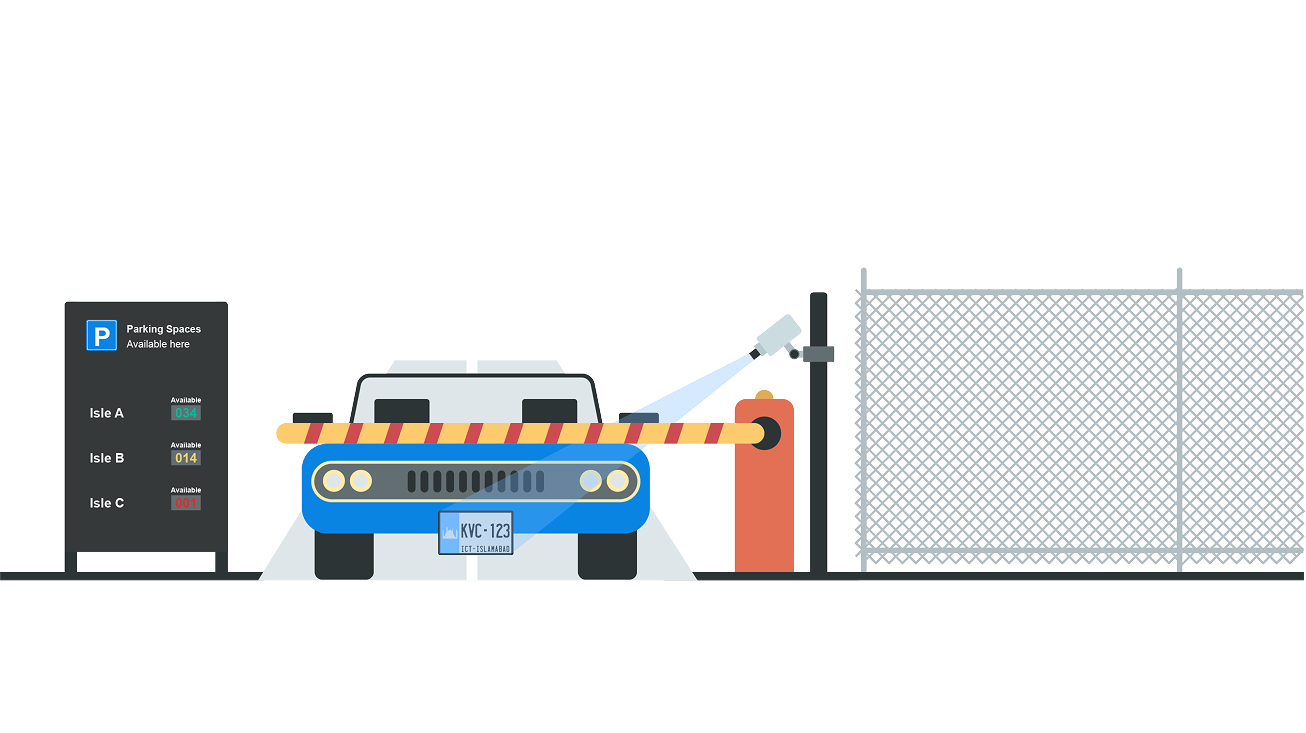
The system combines Automatic License Plate Recognition (ALPR) with real-time parking telemetry, updating live occupancy displays and directing incoming vehicles to available aisles as soon as they approach the entry gate:
Real-Time Vehicle Management & ANPR Telemetry Platform
The Parking & Access Control Challenge
Traditional parking and vehicle gating systems rely on manual ticketing or proximity RFID cards, creating severe operational friction:
- Gate Congestion: Ticket dispensing and manual card tapping slow down ingress during peak office hours.
- Static Occupancy Tracking: Facility managers lack real-time visibility into per-aisle (Isle A, Isle B, Isle C) capacity.
- Plate Variability & Environmental Factors: Vehicle plates vary by regional font (such as ICT - Islamabad plates), perspective angles, and low nighttime lighting.
Technical Pipeline & Model Architecture
The KVMS engine coordinates three primary visual and telemetry processing layers:
1. Optical Vehicle & Bounding Box Isolation
As a vehicle approaches the ingress barrier, high-framerate IP cameras capture raw video streams. The edge detection module isolates the vehicle front fascia and extracts candidate bounding boxes containing license plates:
- Applies adaptive contrast normalization and edge-sharpening filters to overcome headlight glare and shadowed bumpers.
- Filters out non-plate rectangular artifacts using geometric aspect ratio thresholds.
2. Character Segmentation & k-NN / CNN Recognition
Extracted plate regions are passed to a dual-stage optical character recognition (OCR) classifier tailored for standard and regional plate typographies (including Islamabad ICT plates):
- Binarization & Deskewing: Corrects perspective distortion caused by off-center camera mounting angles.
- Character Parsing: Segments individual characters (e.g.,
KVC - 123) and evaluates them against trained k-NN and Convolutional Neural Network (CNN) character feature maps. - Sub-120ms Latency: Executes full inference locally on edge hardware, emitting gate trigger signals before the vehicle comes to a complete stop.
3. Real-Time Parking Telemetry & Guidance Routing
Once a vehicle is validated, the system updates facility state databases over WebSocket channels:
- Decrements available slot counters for the targeted zone (e.g. Isle A: 034 $\rightarrow$ 033).
- Instantly transmits updated counts to outdoor digital LED displays and indoor overhead signage.
- Logs entry timestamps, plate strings, and assigned parking zones for security auditing.
Architectural Principles Learned
- Edge inference is mandatory for barrier control: Cloud-dependent ANPR introduces latency spikes during network drops. Running local inference guarantees sub-120ms gate response times.
- Combine ALPR with facility telemetry: Plate recognition gains additional utility when tied directly to dynamic aisle guidance, reducing driver search times in complex parking structures.
- Adaptive pre-processing overcomes environmental glare: Normalizing ambient lighting extremes prior to character segmentation drastically improves OCR accuracy on dirty or reflective metal plates.